Energising Development (EnDev) is an Energy access partnership financed by the Netherlands, Germany, Norway, United Kingdom, Switzerland and Sweden, and implemented in 26 countries in Africa, Asia and Latin America by the Netherlands Agency and of the Deutsche Gesellschaft für Internationale Zusammenarbeit (GIZ).
The aim is to promote sustainable access to modern energy services that meet the needs of the poor - long lasting, affordable, and appreciated by users. The monitoring and evaluation of all activities is very strict to ensure high quality and efficiency. Since 2005, EnDev has taken a leading role at promoting access to Sustainable Energy for All, and promotes information at www.energypedia.info.
Since 2012, GIZ/EnDev Liberia focuses on strengthening the renewable energy sector in Liberia, bringing in technical expertise for information and knowledge exchange, trainings (Installation, lamp repair, stove construction….), networking. Since 2014, EnDev is also active in Sierra Leone and with few activities in Guinea.
EnDev Liberia aims to ensure sustainable and affordable access to renewable energy all over Liberia. This is done by strengthening markets and collaborating with various partners from public and private sector as well as NGOs in four focus areas.
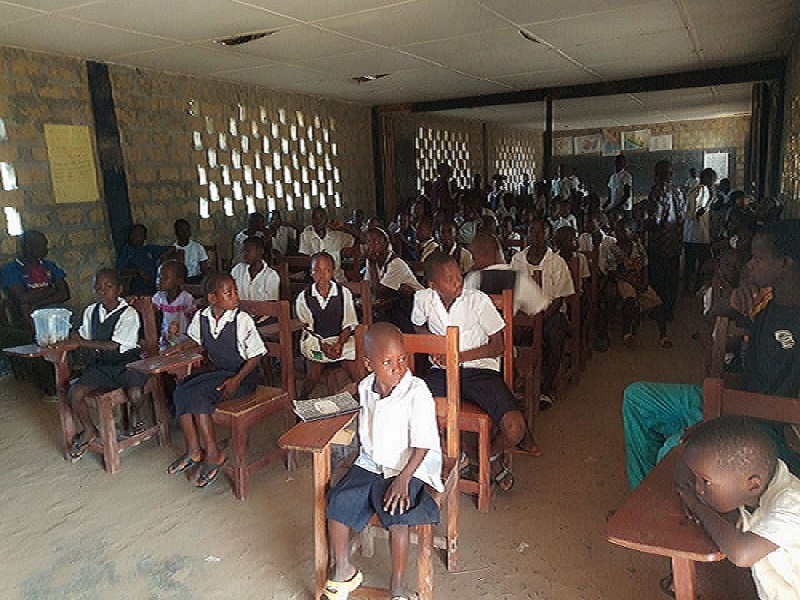
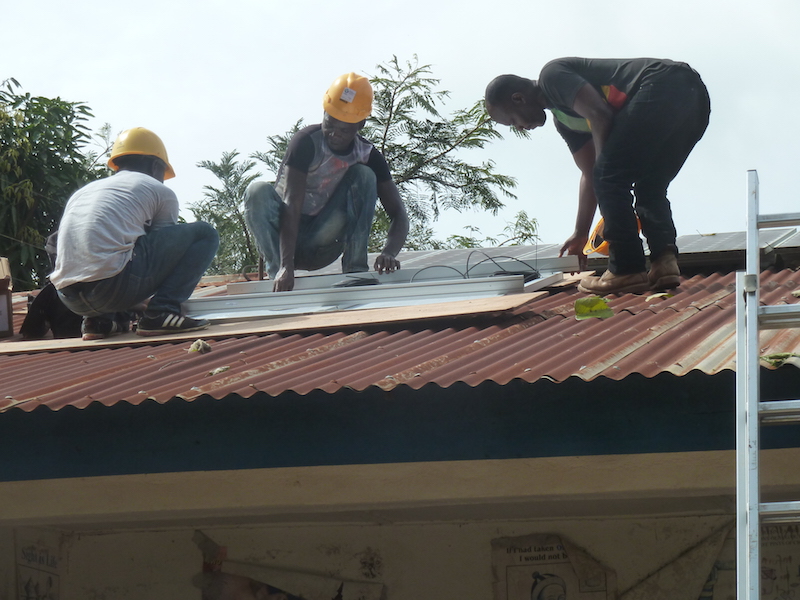 Installations of solar home systems or larger systems for public facilities or communities are a key to energy access in rural Liberia. As part of the Ebola support and in collaboration with other projects, EnDev has been involved in installing solar systems in health facilities and schools in various facilities in Liberia, Sierra Leone and Guinea.
Other activities to promote solar installations are establishing a repair hotline, trainings for solar technicians, pioneering solar installations for offices and gas stations, developing an app for solar system registration, monitoring and repair.
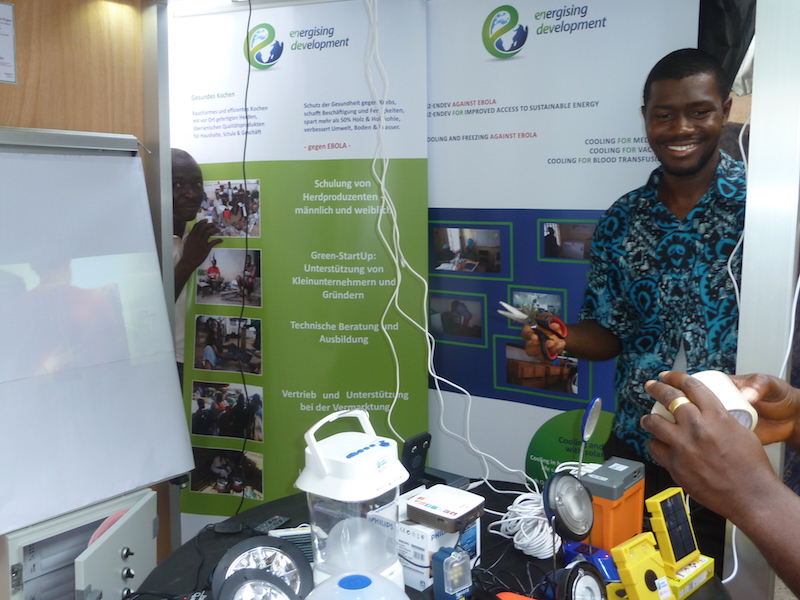
The EnDev solar promotion car uses solar panels for producing popcorn, music, showing movies and informing about solar and solar products, supporting retailers in promotional activities.
Collaborating with small NGOs, EnDev empowers small businesses to start selling solar products. Also, quality tests of solar lamps and trainings for repairing the products help to keep the quality high.
Read more about EnDev activities promoting Pico PV products.
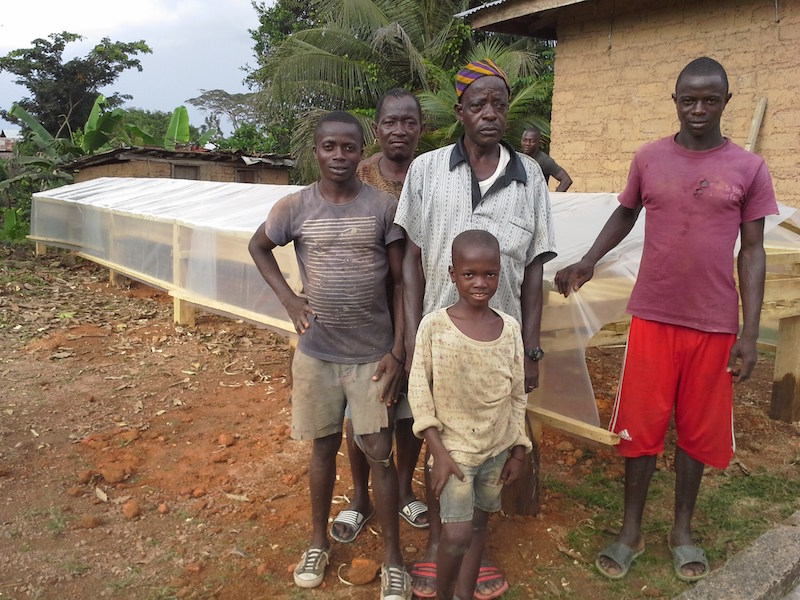 Using the heating energy of the sun for drying agricultural products, such as cocoa, can increase productivity and income of farmers. GIZ/EnDev introduced a solar dryer that is easy to build and handle, supported construction of more than 270 dryers and trained over 120 farmers in maintenance.
In collaboration with others in the cocoa sector, GIZ/EnDev works towards information sharing as well as robust and efficient solar dryers.
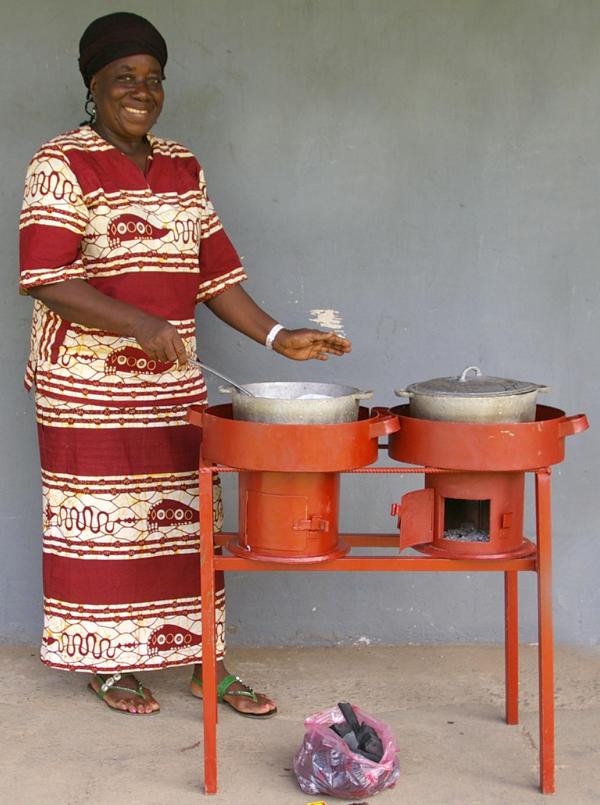 Most households in Liberia use firewood or charcoal for cooking. EnDev introduced various improved cook stoves that use less fuel, produce less smoke and shorten cooking time.
The Red Fire Pot was developed for Liberia, local metal workers were trained to produce it. EnDev still supports production, marketing and sales towards establishing a market for it.
EnDev also tests and works towards improving other stoves, for instance institutional fire wood stoves that can be used for school feeding or cooking for larger groups. Read more about EnDev activities for improved cook stoves.
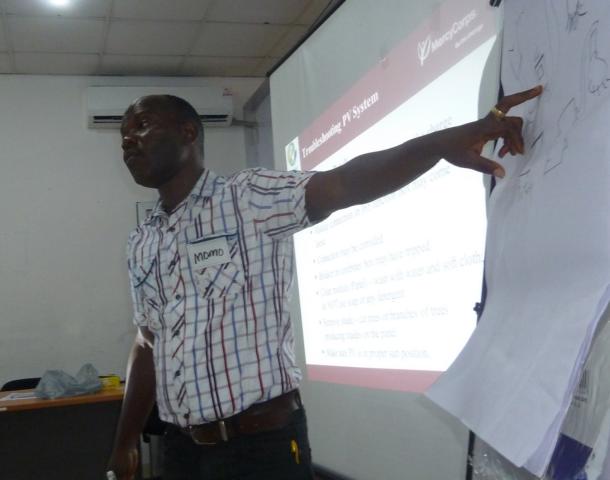
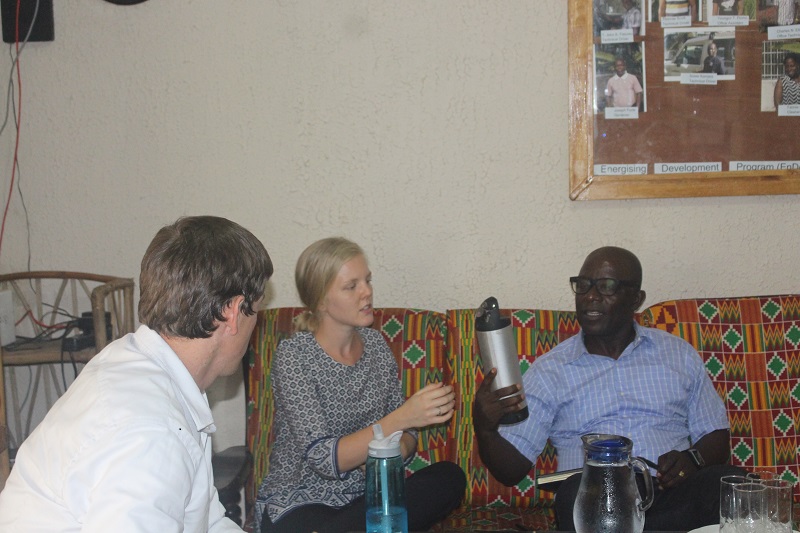
A key field of activities for EnDev Liberia is to share technical expertise to build capacities for sustainable renewable energy use. The trainings and workshops are demand-driven and tailored to the needs of the target group. Examples of trainings include:
Read more about some recent trainings: improved cook stoves, SMA solar system, hands-on solar system installation training.
EnDev Mano River promotes digital information and communication technology (ICT) solutions to enhance the renewable energy sector. This includes a sophisticated app, a mapping tool and the web portal www.renewables-liberia.info. A similar website for Sierra Leone is under construction.
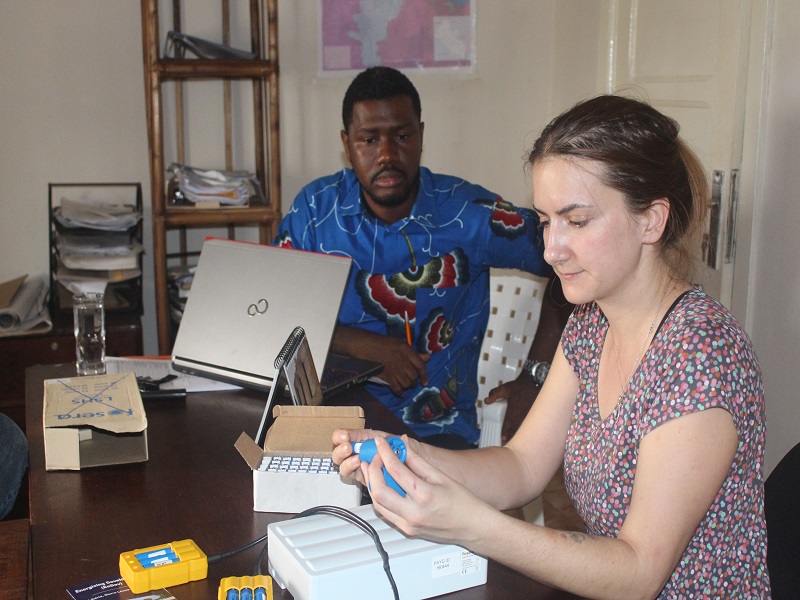
The GIZ/EnDev office, located at the back road, oldest Congo Town, Monrovia is fully powered by solar systems without any back-up. The office hosts an exhibition of solar product and improved cook stoves. Visitors are welcome.

From October 2010 to Octover 2014, Winrock International received $21.9 million from USAID to implement the Liberia Energy Sector Support Program (LESSP). The aim of this four‐year program was to increase access to affordable renewable energy services to foster economic, political and social development. Specifically, the aims were
The final evaluation report of the proram concluded that at time of LESSP’s closure most activities were incomplete.
It was planned to establish four pilot projcts using renewable energies to generate power in rural areas. Two of the original pilot projects were removed from the contract, and replaced with new projects in different locations, and with a completely different scope of work and technical specifications.
The evaluation report of the project summarizes lessons learned to improve reaching Development objectives (DOs).
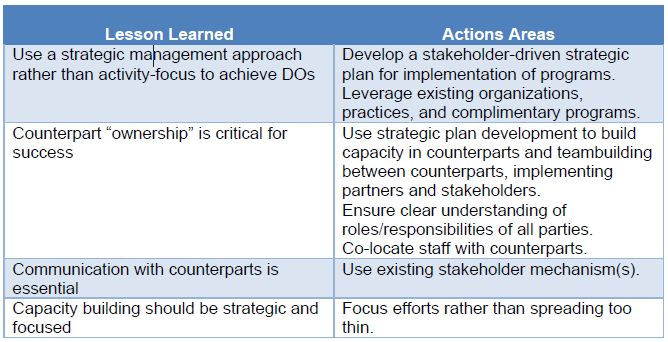
Some of their recommendations for future projects are the following:
Take into account the limited local resources, lack of pertinent quality data and logistical challenges as well as lessons learned.
The government, international donors and various NGOs collaborate in various larger development programs or projects that include renewable energies. To add projects please use and submit this template.
|
Name |
Key activities |
Implementer |
Region |
Funded by |
Duration |
| Regional Off-Grid Electrification Project (ROGEP) |
TA for off-grid market; loans for electricity service providers; Support to electrify public institutions. |
ECREE | 19 countries: 15 West Africa (including Liberia), 4 Sahel | World Bank | 2017- 2022 |
|
Hybrid hydropower and Diesel plant and grid in Lofa, Capacity Building; Market development of stand-alone solar systems |
RREA |
Lofa, nation-wide |
Strategic Climate Fund Grant, Worldbank |
28-Jan-2016 to 30-Jun-2021 |
|
|
Strengthen Renewable Energy Sector, Promotion of solar technologies, Pico PV, cocoa solar dryers, improved cookstoves |
GIZ/EnDev |
Nation-wide |
Netherlands, Germany, UK, Australia, Norway, Swizzerland |
2012-2018 |
|
|
Curriculum Development, Market Facilitation, Financial service and Pico-grid installation Contact persons are:Orlando S. Kanswen(This email address is being protected from spambots. You need JavaScript enabled to view it.) Julateh K. Mulbah (This email address is being protected from spambots. You need JavaScript enabled to view it.) |
Mercy Corps |
Margibi, Lofa, Nimba, Bong, Grand Bassa, Rural Montserrado, Gbarpolu, |
EU |
March 2016-2019 |
|
| Light Up our Future (LUOF) |
Solar electrifying five remote communities |
PLAN International, VOSEIDA | Lofa | EU | 2015-2017 |
| Mt. Coffee Hydropower Rehabilitation Project |
Rehabilitation of hydropower plant (generating units, powerhouse, intake, dam and spillway) and reservoir, 132/66 kilovolt (kV) substation, two
132/66 kV transmission lines, expansion of receiving substations in Monrovia.
|
Manitoba Hydro International, Norplan Fichtner, Voith, Dawnus, Andritz, Ncc, Eltel, Psm Jv, Hydro Operation International |
Montserrado |
Norway (Ministry of Foreign Affairs), Germany (KFW Development Bank, European Investment Bank), USA (Millenium Challenge Corporation), GoL |
May 2012- Dec. 2017 |
| REACT SSA | Partial grant and business in10 countries including Liberia | AECF | Nation-wide | Swedish Embassy | |
|
Solar suitcases for maternity wards |
We Care Solar, UNICEF, GIZ/EnDev, Africare, PHIL |
Nation-wide |
UNDESA, UBS Optimus Foundation, Gilead Foundation and private donors |
2016-18 |
|
| Liberia Accelerated Electricity Expansion Project (LACEEP) | Extension, transmission and distribution of grid; transport and storage of heavy fuel; capacity building in electricity sector | Ministry of Lands, Mines and Energy | Monrovia, Kakata, Kakata Highway | World Bank,
International
Development
Association
(IDA)
|
2013-2020 |
| Liberia Renewable Energy Project | 9.34 MW mini-hydro power plant at Gbedin Falls | Nimba county | AfDB | 2018- | |
| Concessions in South East | TA on how private sector can be attracted to 5 major settlements in S.E. First financial pre-feasibility study - Gbanga prioritised | TBD | South East: Cestos city, Greenville, Barclayville, Harper, Pleebo, Fish town, Zwedru, Tappita, and Gbarnga | EU | ongoing |
|
Rehabilitation of Mt. Coffee hydroelectric plant, pilot projects, road rehabilitation |
NRECA |
|
USAID |
2015- |
|
|
Technical Assistance for reduction of maternal mortality in Liberia |
Telemedicine support for midwives, trainings, solar installations, smartphones |
Epos, MoH, GIZ/EnDev |
Grand Gedeh |
EU |
2017 |
| Liberia Energy Efficiency and Access Project (LEEAP) | Constructing transmission and distribution lines, capacity building | LEC | Montserrado, Bomi, River Gee, Maryland |
AfDB, TSF, NTF, EU, GEF, GoL |
2017-2019 |
| Skip the Grid | Electrification: Bringing solar power to health facilities. | RREA, ELCA | Liberia | Donations | started in 2017 |
|
Name |
Key activities |
Implementer |
Region |
Funded by |
Duration |
|
Solar electrifications, elaboration of regulations, market support for stand-alone solar systems.
|
RREA |
Nationwide |
Global Environment Facility (GEF) Trust Fund Grant, World Bank. |
2012-2017 |
|
|
Renewable Energy Sources to Rural Primary Health Care Facilities |
204 health facilities in 15 counties received DC solar installations, 410 health facility staff were trained in maintenance of solar systems.
|
Merlin, Save the Children International- Liberia |
Nationwide |
EU Energy Facility II and the Government of Liberia |
|
|
Cross-border Supply of Electricity to Rural Communities in Liberia from Cote d'Ivoire |
|||||
|
Developing a Rural Energy Strategy and Master Plan for Liberia |
Support RREA, developinto a strong, independent, efficient, and sustainable organisation capable of achieving Liberia’s target of increasing access to modern energy services in the rural areas. | RREA | Monrovia, Lofa, general | EU | August 2011 to April 2016 |
|
Advancing Youth Project |
Increased access to basic education, skills training for out-of-school youth, solar installations in 142 public schools |
EDC |
Montserrado, Margibi Bong, Lofa, Nimba, Grand Bassa |
USAID |
2011-2016 |
| Capacity building, four pilot projects electrifying rural communities with renewable energies (biomass, hydro, solar) | Winrock International received | Lofa, Nimba, Bong | USAID | 2010-2014 |
The Light Up Liberia (LUL) Program is a European Union funded project implemented by Mercy Corps Liberia. The overall objective of the Light up Liberia program is to reduce poverty and improve stability and living conditions of the rural poor in Liberia.
The Program seeks to achieve three specific objectives (SO):
To achieve these objectives, the Program will work towards the following results/outputs:
In order to implement the overall objective of the Light Up Liberia Program, implementation has been divided into four major components. The four components are:
The Light Up Liberia Program runs from April 2016 to March 31,2019.
Contact Persons are Orlando Kanswen email:This email address is being protected from spambots. You need JavaScript enabled to view it., Julateh k. Mulbah This email address is being protected from spambots. You need JavaScript enabled to view it.